


Antenna Gain Explained: What dBi Actually Means for Your IoT Network



TL;DR
- Gain reshapes coverage, it does not add power. dBi measures how far an antenna departs from a perfect sphere of radiation.
- Higher gain flattens the donut. A 3 dBi antenna covers 360 degrees; a 9 dBi antenna concentrates into roughly 25 degrees of vertical beam.
- More gain does not automatically mean more range. RAK measured the same 8.6 km with 5 dBi and 9 dBi antennas, and nothing at all at 11 km with either.
- The headline number is a peak. An antenna sold as 8 dBi measures 6.3 dBi at the bottom of its band, at 50 percent average efficiency.
- Regulation caps radiated power, not gain. In Europe the ETSI ceiling is 25 mW ERP, so more gain means turning the transmitter down.
- Connectors can erase the upgrade. Two SMA connectors cost around 2 dB, most of the 3 dB gained by moving from 5 dBi to 8 dBi.
- Choose by coverage shape, not by the biggest number. Circle around the mast means low or medium gain. One known direction means directional. High mounts need downtilt.
RAKwireless engineers put a gateway for LoRaWAN® on a 100 metre rooftop, pointed it at a node 8.6 km away across open ground, and measured the link twice. Once with a 5 dBi antenna. Once with a 9 dBi antenna. Then they pushed the node out to 11 km and tried again.
At 11 km, neither antenna received a single packet.
Four extra decibels bought exactly zero additional kilometres. That is not a faulty antenna or a bad test. It is working as designed, and it tells the buyer something quite different from what most people assume.
Antenna gain, measured in dBi, describes how an antenna concentrates radio energy compared with a theoretical antenna that radiates equally in every direction. It does not add power. A higher-gain antenna narrows the vertical beam and pushes the same energy further out sideways, trading overhead and nearby coverage for distance.
Understanding that one sentence is the difference between buying an antenna that fits your site and buying the biggest number on the shelf.
What antenna gain actually measures
Start with the reference point, because dBi is meaningless without it.
The "i" stands for isotropic. An isotropic antenna is a hypothetical object that radiates perfectly evenly in every direction, a flawless sphere of signal. RAK's primer on IoT antenna fundamentals suggests picturing the sun, then notes the catch: such an antenna "cannot exist on our planet."
Every real antenna departs from that sphere. Push energy in one direction and it must come from somewhere else, because the total stays fixed. Gain measures that departure at its strongest point, and The Things Network's reference on dB, dBm, dBi and dBd sets out the arithmetic: 3 dB doubles power in a given direction, 10 dB multiplies it tenfold, and a standard dipole sits 2.15 dB above isotropic.
So a 3 dBi antenna is not "weak" and a 12 dBi antenna is not "strong". They are differently shaped. One spreads a modest amount of energy across a wide area. The other stacks the same energy into a narrow slice. Antenna gain describes the shape of that trade, nothing more.
The donut, and what happens when you squeeze it
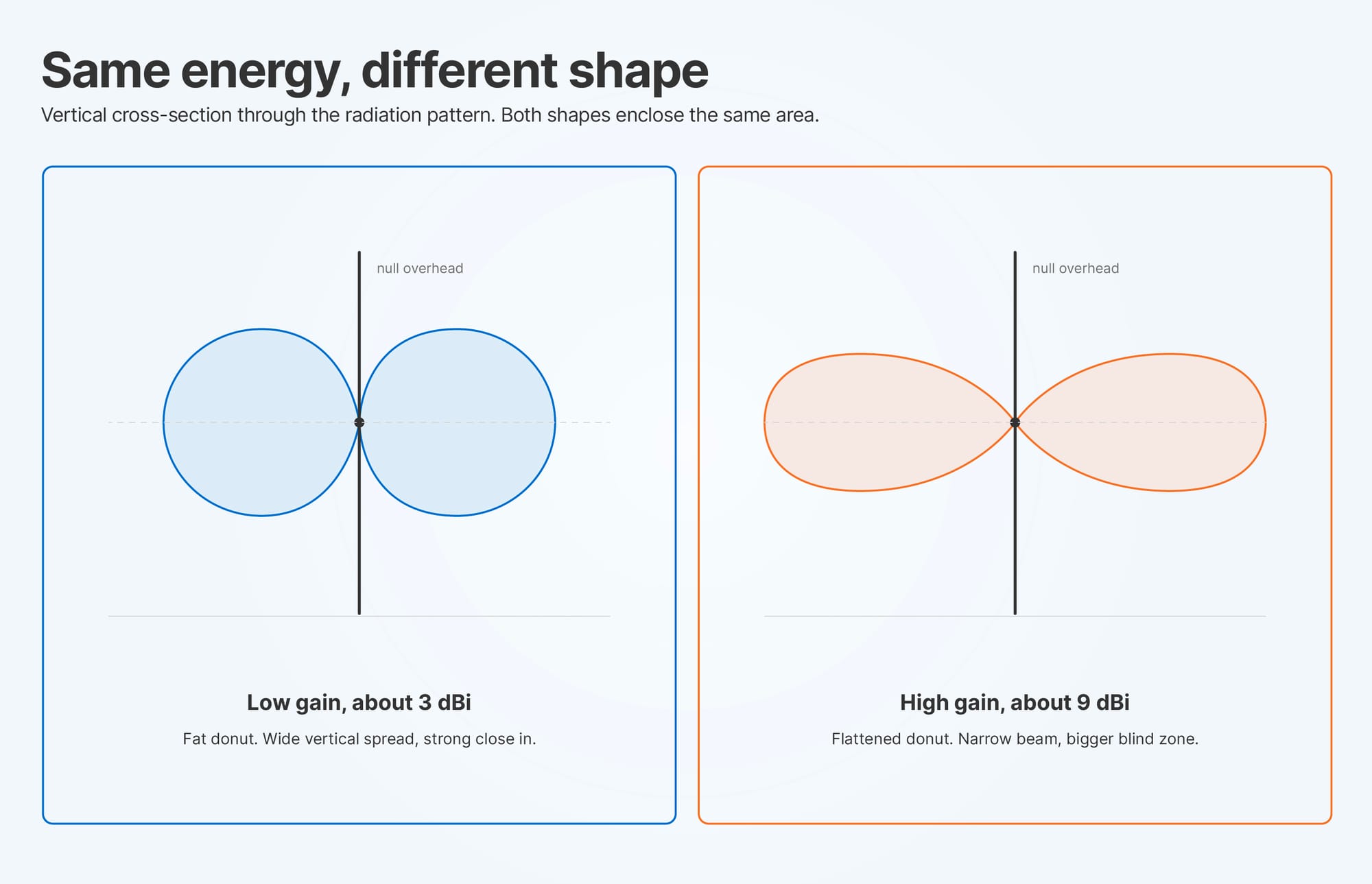
A vertical omnidirectional antenna does not radiate a ball of signal. It radiates a donut, with the antenna standing through the hole. The signal goes out sideways in every compass direction, and almost none goes straight up or straight down.
That donut is the radiation pattern, the single most useful thing on any antenna datasheet.
Now add gain. Raising gain does not inflate the donut. It squashes it. The pastry spreads wider and flatter while the hole in the middle grows. RAK publishes the numbers on its own product pages: 3 dBi covers the full 360 degrees, 5 dBi concentrates into roughly 40 degrees of vertical beam, 7 dBi into 30 degrees, and 9 dBi into just 25.
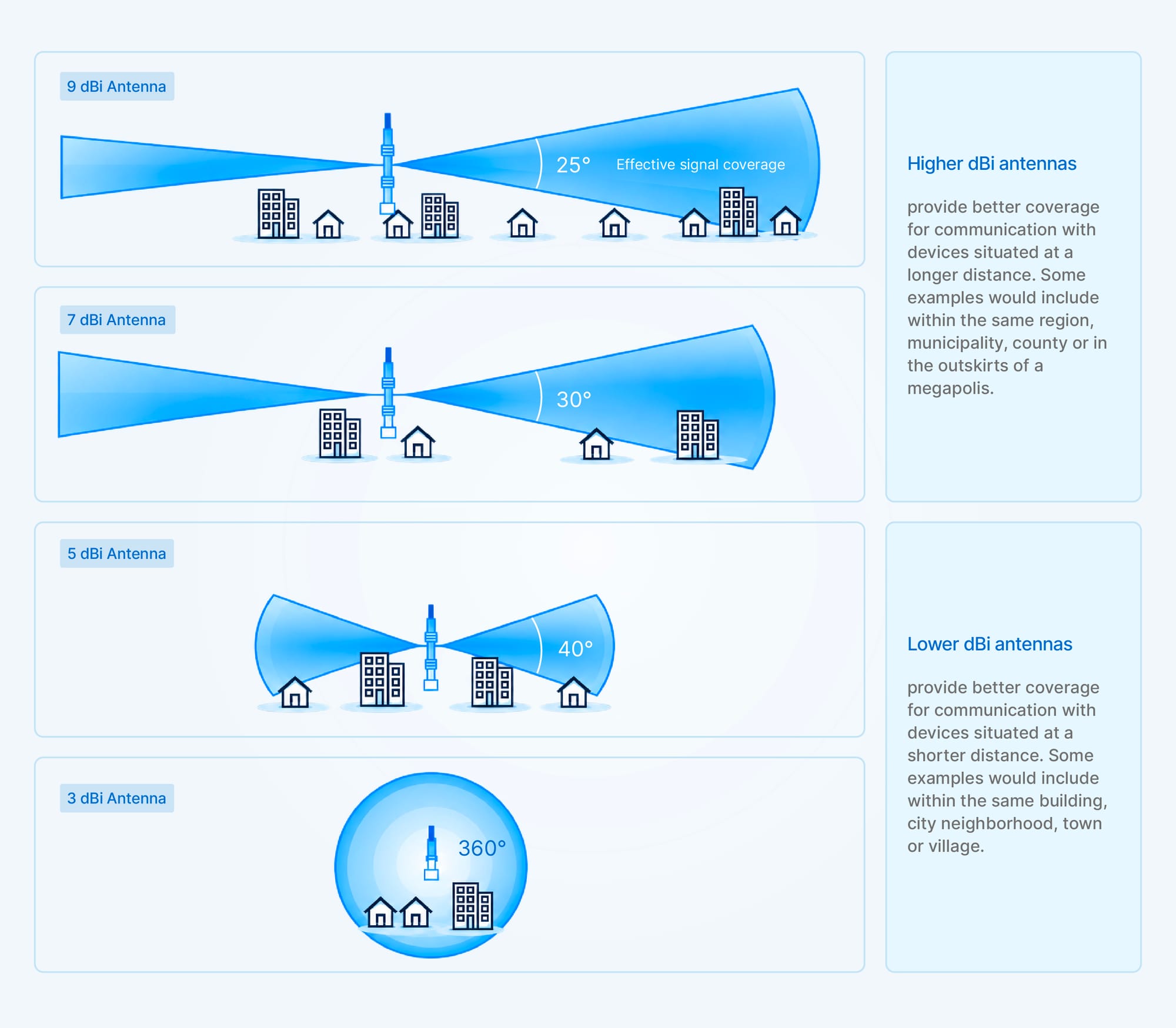
Twenty-five degrees is a narrow window. Mount that antenna high without tilting it toward the ground and the beam sails over everything nearby, delivering its energy to the horizon and to nothing in between. RAK's guide to choosing the right antenna for your IoT deployment states the trap plainly: a high gain antenna mounted too high or tilted incorrectly overshoots nearby targets, and mounted too low it gets blocked by obstacles.
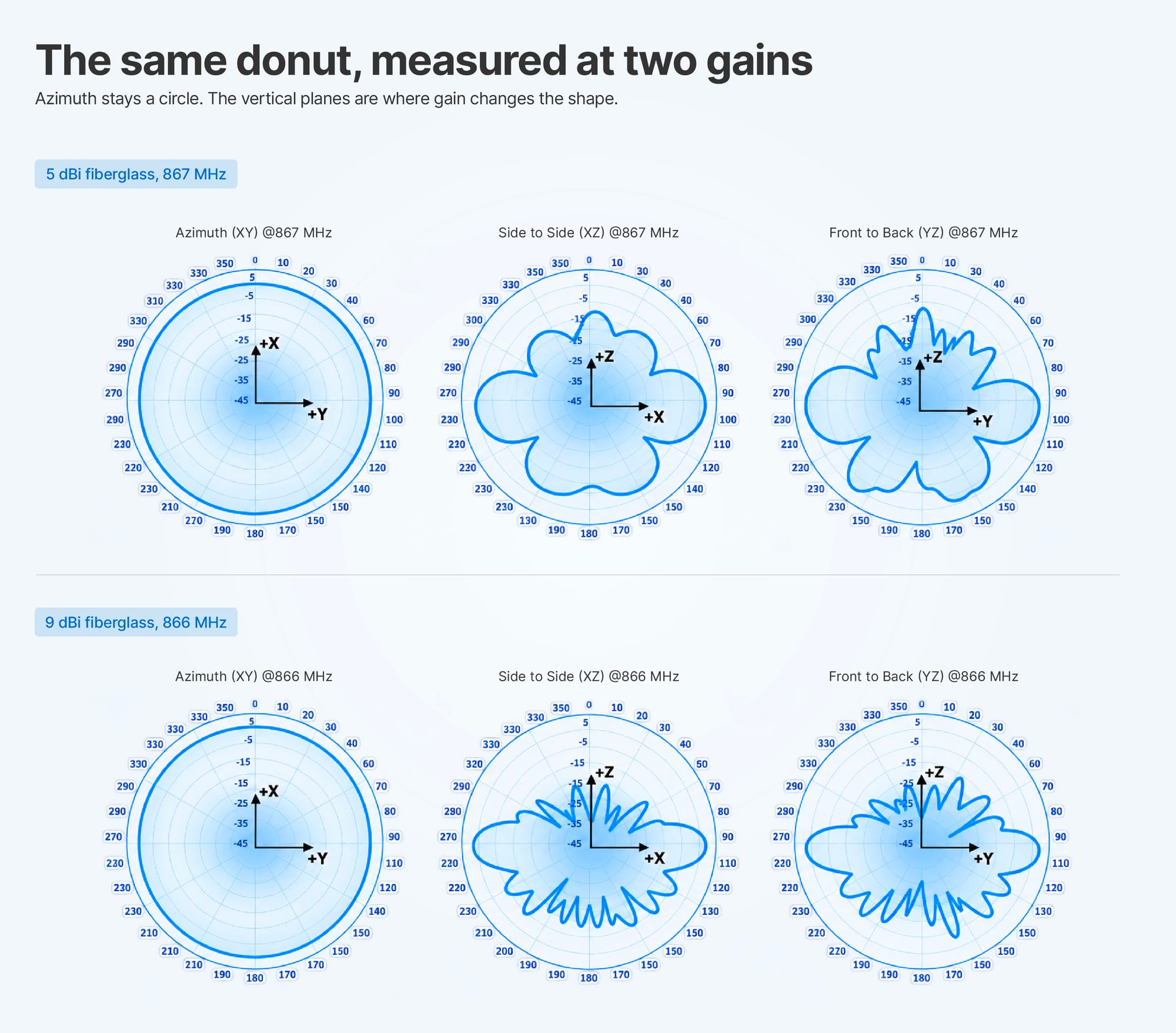
The squeeze shows up in measured data. Across polar plots for a 5 dBi and a 9 dBi antenna from the same test, the horizontal plane stays a near-perfect circle in both. The vertical planes tell the real story: broad rounded lobes at 5 dBi, and at 9 dBi a starburst of narrow spikes separated by deep nulls where almost no signal reaches.
What the field test actually found
Which brings us back to that rooftop. RAK's published LoRaWAN range test held everything constant except the antenna: same gateway, same node, 20 dBm transmit power, LoRa® spreading factor 12, a 32 byte payload, direct line of sight.
At 8.6 km on EU868, the 5 dBi antenna averaged −101.5 dBm and the 9 dBi averaged −98.5 dBm. A genuine 3 dB improvement in received signal. At 11 km, both recorded the same result: no packets received.
The 12 dBi directional antenna managed a handful of packets at 11 km where the omnidirectionals managed none, which is what a directional antenna is for. Yet on US915 at that distance it measured −113.2 dBm, marginally worse than the 9 dBi omnidirectional's −112.6 dBm, at several times the price.
RAK's conclusion is the whole argument in one line: higher gain "results in greater directivity, more concentrated energy, and a narrower lobe," and when mounted high, "the antenna should be tilted towards the ground at an appropriate angle."
A second lesson is buried in that test. US915 cleared 11 km on a 5 dBi antenna while EU868 failed on a 9 dBi one, and RAK attributes the gap to the antenna on the node, not the gateway. A radio link is set by its weaker end, so upgrading only the gateway antenna spends money on the side that was already working. A note on what to actually order. The gains in this test are the ones RAK measured, not a product list. RAK's outdoor antenna range runs 3, 5, 5.8, 8 and 12 dBi, so if you are Understanding from these results, the 8 dBi fiberglass sits closest to the 9 dBi tested here, and the 12 dBi directional is the same unit described above. The full range is on the outdoor antenna page.
Matching gain to coverage shape
Here is how the three shapes compare in practice, using RAK's published specifications.
Notice the length column. A collinear antenna achieves gain by stacking dipoles in a vertical line so their radiation adds up, which is why the 8 dBi model is two and a half times longer than the 3 dBi one. If you want a narrower beam, you have to buy more antennas.
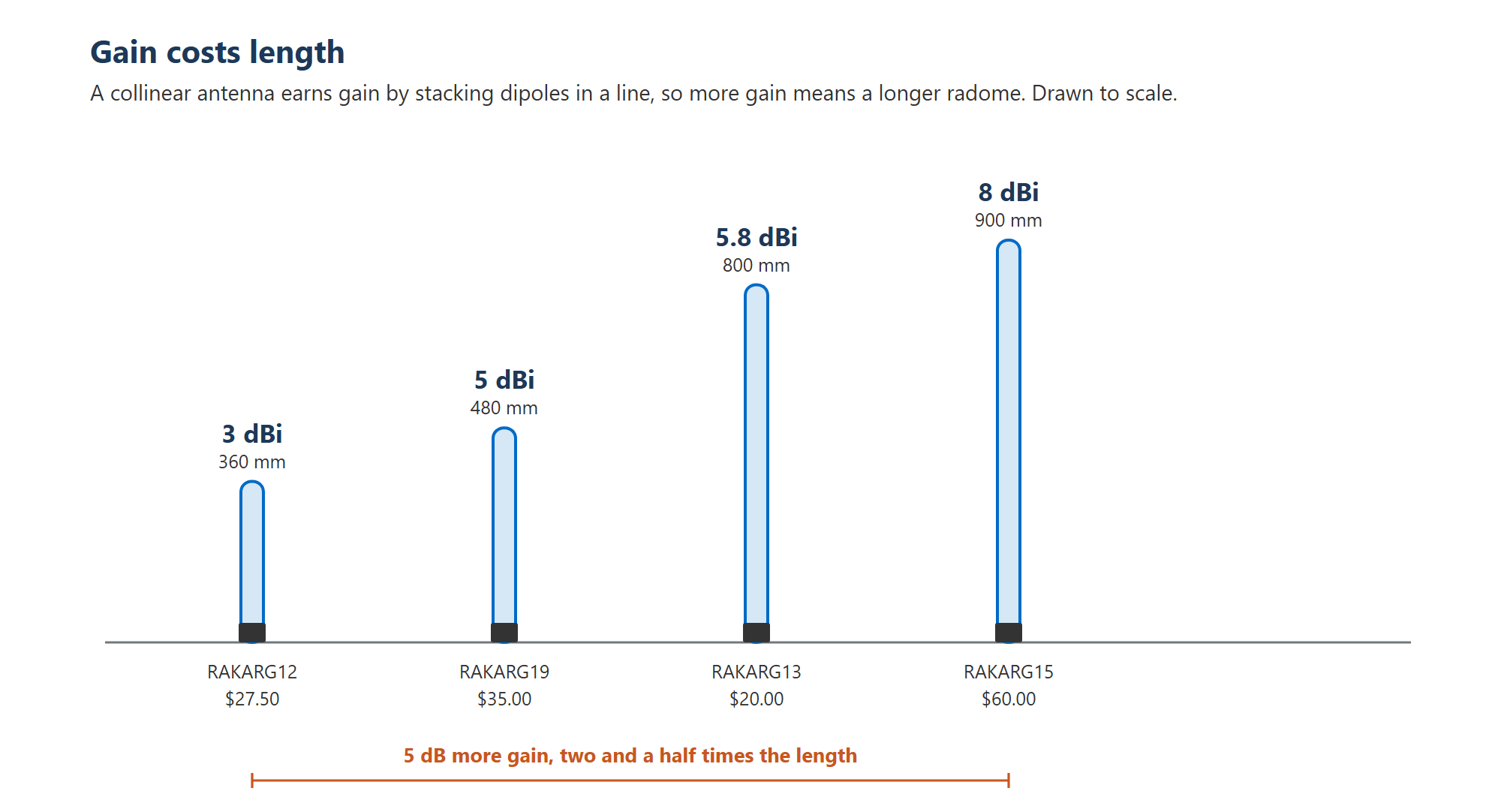
RAK's own store copy maps the ladder the same way: 3 dBi for close-in urban coverage with fewer blind spots, 5 to 5.8 dBi for town-to-suburb reach, 8 dBi for long-range rural links, and 12 dBi directional to focus signal where the devices actually are. Indoors the calculation changes again, and a compact Blade antenna of around 2.3 dBi is what ships with RAK's own indoor gateways, because inside a building you want signal in every direction including up the stairwell.
Three things the dBi number does not tell you
The headline figure is a peak, not a constant
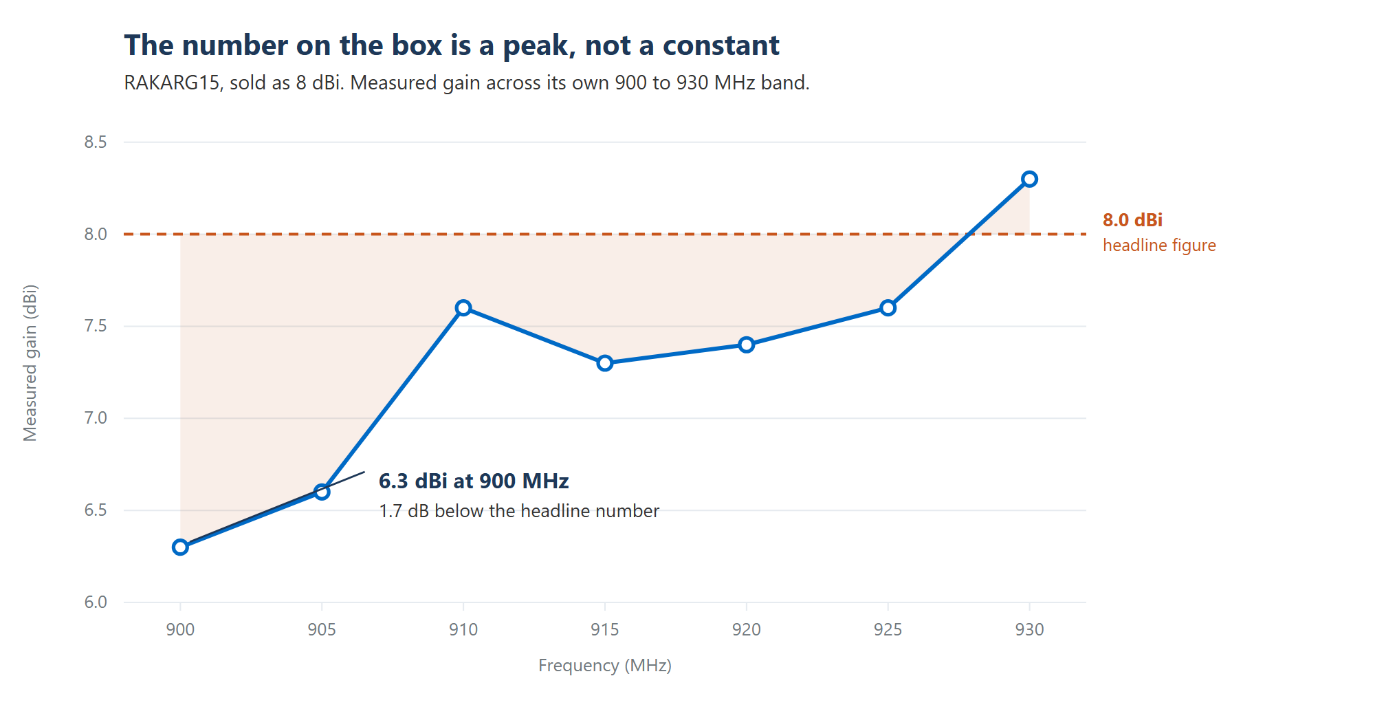
Datasheet gain is the best number the antenna achieves anywhere in its band. RAK publishes the full sweep for its 8 dBi model, and it measures 6.3 dBi at 900 MHz, climbing to 8.3 dBi only at the very top of the range. Average radiating efficiency across the band is 50 percent.
The 3 dBi model measures 2.6 to 3.1 dBi, at efficiencies between 56 and 77 percent. The cheaper, lower-gain antenna is the better radiator of the two. Gain and efficiency are different properties, and only one of them appears in the product name.
There is a ceiling, and gain cannot raise it
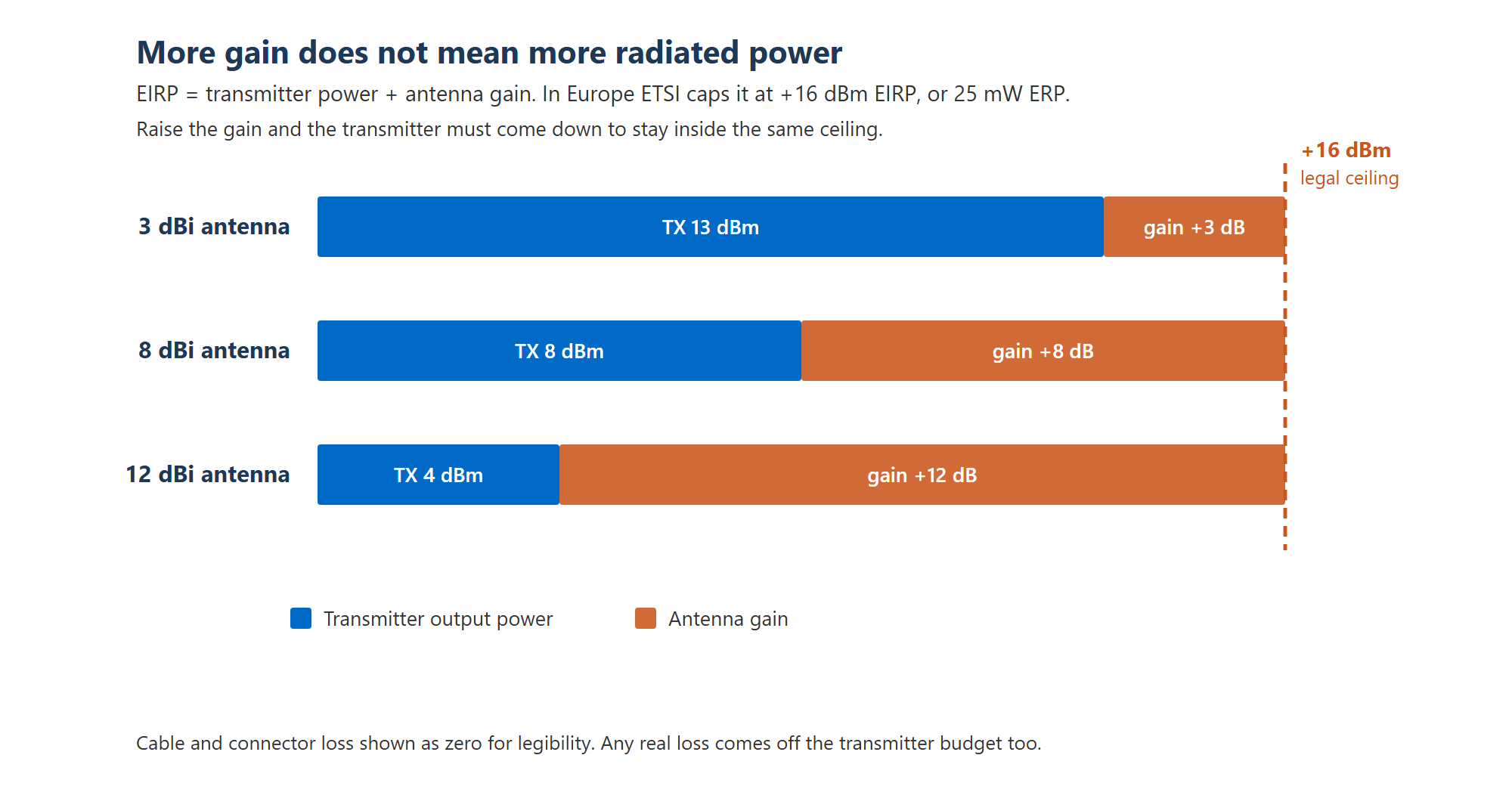
This is the part that surprises people most. Radio regulators cap what leaves the antenna, not what the antenna is rated at. As The Things Network's EIRP reference sets out, effective isotropic radiated power is transmitter power plus antenna gain minus cable loss, and in Europe ETSI caps it at 25 mW ERP, equivalent to +16 dBm EIRP.
Fit a higher-gain antenna and you do not radiate more total energy. You have to turn the transmitter down to stay legal. The gain has simply changed the shape of the same permitted budget. Regional limits differ, and the LoRa Alliance Regional Parameters are the authority for your band.
Connectors quietly hand some of it back
Upgrading from 5 dBi to 8 dBi buys you 3 dB. RAK's guide to antenna RF connectors puts SMA and RP-SMA insertion loss at 0.6 to 1 dB each at LoRa® frequencies, with a working rule of adding 2 dB to the link budget for every pair of connectors. N-type stays under 0.3 dB and is the outdoor standard partly for that reason.
Two sloppy connectors can therefore erase most of the difference you just paid for. Low-loss coax and the right antenna accessories protect the gain you already have, which is usually cheaper than buying more.
How to choose, in four questions
- What shape is your coverage area? A circle around the mast points to low or medium gain. A long corridor or one distant cluster points to a directional antenna.
- How high is the mount, and what sits below it? The higher the mount and the more devices cluster near its base, the more a narrow beam overshoots them. Plan downtilt before you buy.
- What is at the other end? The weaker end of the link sets the range, whatever the gateway is wearing, so match the node antenna to the band.
- Indoors or outdoors? Indoor sites want wide patterns and small packages. Outdoor sites want IP67 sealing, N-type connectors and a mount that survives wind.
RAK's antenna selector tool narrows the field by range, environment and frequency, which beats reading twenty datasheets. From there the outdoor and indoor ranges cover most cases, the custom antenna design service covers simulation and anechoic chamber testing when nothing off the shelf fits, and the free guide to antenna design for LoRa and NB-IoT devices goes deeper on embedded designs.
One note from RAK's own product documentation is easy to miss and worth acting on: across a network, combining antennas of different gain usually beats standardising on the highest number. Mixed gain fills in the blind spots a uniform high-gain deployment leaves behind.
Frequently asked questions
What does antenna gain mean?
Antenna gain describes how strongly an antenna concentrates radio energy in its best direction, compared with a theoretical antenna that radiates equally everywhere. It is a measure of shape and focus, not of added power. An antenna cannot create energy, it can only redistribute what the transmitter supplies.
What is dBi in antennas?
dBi means decibels relative to isotropic. An isotropic antenna is a hypothetical reference that radiates uniformly in all directions and has 0 dBi of gain. Every real antenna concentrates energy somewhere, and dBi measures how far it departs from that perfect sphere at its strongest point.
Does higher dBi mean a better antenna?
No. Higher dBi means a narrower beam, which helps only if your devices sit inside that beam. In a controlled RAK field test, a 5 dBi and a 9 dBi antenna reached the same 8.6 km, and both failed at 11 km. Higher gain also creates blind spots close to the mast.
How does antenna gain affect range?
Gain adds to the link budget, but only along the direction it concentrates energy, and only if nothing else limits the link first. Regional EIRP caps, cable and connector losses, terrain, and the antenna at the far end all constrain range. In the test above, 4 dB of extra gain improved received signal by roughly 3 dB but added no usable distance.
What antenna gain do I need for my deployment?
Match gain to coverage shape. Choose 3 dBi for dense urban sites and hilly ground where devices sit near and below. Choose 5 to 5.8 dBi for suburban coverage. Choose 8 dBi for flat rural terrain with clear line of sight. Choose a directional antenna only when devices sit in one known direction.
What is a radiation pattern?
A radiation pattern is a plot of where an antenna actually sends its energy, usually drawn as polar charts in the horizontal and vertical planes. A vertical omnidirectional antenna produces a donut shape, and higher gain flattens that donut, widening the reach sideways while deepening the blind zone above and below.
Do the same gain principles apply to LoRa and LoRaWAN antennas?
Yes. Gain, radiation pattern and beamwidth are properties of antenna physics, not of any protocol, so they behave identically for a LoRa antenna and a LoRaWAN gateway antenna. What changes between deployments is the frequency band, which determines antenna tuning, and the regional EIRP limit.
LoRa® is a registered trademark or service mark of Semtech Corporation or its affiliates. LoRaWAN® is a licensed mark of the LoRa Alliance®.